Sunday, August 26, 2012

Mantis and Tricho: quick notes

Yesterday afternoon I was looking out the living room window at the beautiful display of red Bird of Paradise, when I noticed an odd green pod hanging from one of the blossoms. A hummingbird flew to the blossom, then took off almost immediately when the pod tried to grab it. I ran outside and saw a huge praying mantis waiting for the hummer to come back. I grabbed it and threw it as hard as I could. Don’t know if I killed it. I didn’t think to photograph it first, but here’s a picture of one of the blossoms:

            Mexican Bird of ParadiseRed Bird of Paradise Blossom

This morning the lone bud on my beautiful trichocereus opened, just until the sun was overhead. So beautiful. The second time this season it’s bloomed.

                            TrichocereusDSCF2010

Saturday, August 25, 2012

A Late-August Week in the Park

These are the uncomfortable days of late summer—hot but not scorching, and very humid but mostly not rainy. Still, Tohono Chul Park is always a very special place to be.

Tree Tragedy

Monday morning, the big news was that a huge old palo verde tree in the Sundial Plaza—the center of the Park—had broken in half during the night. It was clear that the center of the tree had rotted, and heavy winds had done it in. Our grounds guys cleared most of it away from the path within an hour.

Palo Verde Down 8-20-2012 8-28-45 AM 3616x2712

Ant-Zap

Friday, I had a bird walk. When it began, the visitors and I noticed a desert spiny lizard behaving oddly inside a ramada. When we got closer, we saw that he was standing by a long line of small red ants (not leaf-cutters), and methodically eating them one by one, bobbing his head as he zapped the ants with his tongue. It looked as if he were playing a video game. I failed to get a photo of this remarkable behavior, but am recording it because I have never seen it before.

Here’s a desert spiny lizard: just imagine him playing Super Mario.

 Desert spiny 4-11-2011 10-43-45 AM 945x825

Birdless Walks

My bird walks on Monday, Friday, and today were pathetic—birders for each of them, but virtually no birds. Too hot, and too much new plant growth to see anything.

But all was not lost. I got to see some of our new sculptures. Here is part of a javelina family group in front of the small pond behind the Exhibit House.

                                                                javelina statues 8-20-2012 9-44-33 AM 3616x2712

Are you Cereus?

And a rare sight this morning: beautiful fruit of the night-blooming cereus.  Our head botanist collects these fruits for their seeds, so I was very lucky to see these before he got to them.

Cereus Fruit 8-25-2012 8-34-47 AM 3616x2712

Saturday, August 18, 2012

Feeding a Snake

Leo, the beautiful kingsnake in my guest room, needs to be fed two mice once every two weeks. His owner, the herpetologist who brings Leo to the reptile show at Tohono Chul Park, feeds him live mice, but correctly assumed I would not want to do that, so he left me a plastic bag of frozen mice. I thaw two out, wait till they reach room temperature, and place them in Leo’s cage. He will not eat in my presence, however.

Here is a video of my attempt to capture the very interesting process by which a snake swallows something larger than its head. I explained this and have a video showing it in a small way in my post on the nightsnake eating a lizard.

Leo sniffing dead mouse

This poorly-lit video still gives you a sense of how terrifying it must be to be a mouse when a snake is approaching. Leo was obviously interested in the mouse, but kept backing off because I was there. I left him alone, and when I came back, the mouse was gone, and Leo had a bulge in his body just above the bulge of the previous mouse.

The next time I checked the cage, Leo was curling up in his water dish. The first time I fed him he soaked for eight hours; this time he was only in there for about three. Leo bathing 7-5-2012 8-22-34 AM 1471x1411


Technorati Tags: ,

Monday, August 13, 2012

Long-nosed Snake Rove

I’m having a very snaky month so far, which is wonderful for someone like me who believes that a day without snakes is like a day without sunshine. This morning I was surprised and delighted to see a beautiful long-nosed snake basking in the hot sun on the main path into the Park. It quickly slithered away before I could quite get it in focus. These gorgeous snakes, Rhinocheilus lecontei,  are smallish constrictors who like to eat lizards.

Longnosed snake shadow 8-13-2012 8-04-06 AM 1123x507

That was the only snake I saw (can’t get greedy, after last week’s nightsnake), but I also saw the eerily beautiful flowers of Stapelia, a South African succulent we have growing in one of our ramadas,

Stapelia 8-13-2012 9-23-20 AM 1251x648

…and the lovely flowers of Cereus grandicostatus, a cactus of uncertain origin that twines in a palo verde near the center of the Park.

Grandicostatus g.  8-13-2012 9-02-36 AM 3021x2474

Since I started this post with snakes, I’ll end with a quick update on Leo, the beautiful kingsnake in my guest room. So far, I’ve only taken him out a few times, but it is a privilege to take care of him and observe him. He has shed his skin once in my care and currently looks shiny and healthy. I have to give him back to his owner soon, and I’ll try to post more pictures before I do. 

Monday, August 06, 2012

Another Rove Filled with Surprises

It rained last night, and this morning the Park was hot and steamy for my rove. A lot of the usual birds were out and about (pyrrhuloxia, cactus wren, Abert’s towhee), and I even saw a roadrunner, not uncommon but not that often seen. About a minute after I saw the roadrunner, a jack rabbit bounded down the path in front of me. Unfortunately I was unable to photograph either of these guys. However….

While climbing a short trail, I encountered two visitors who were watching something. When I approached, they told me a snake was eating a lizard, and could I identify the snake? I took a close look at this rather small, tan, blotched snake, and immediately ruled out rattlesnake. Maybe a baby gopher snake? But there was something strange about the markings, and after a few minutes I realized it was likely a nightsnake (Hypsiglena), which, as its name indicates, is supposed to be a nocturnal animal. This was the first one I’d ever seen in the wild.

Nightsnake eating zebratail 1Nightsnake eating zebra tail lizard (Callisaurus)

Googling tells me that the nightsnake is mildly venomous, with rear fangs, and has smooth scales (unlike a gophersnake, which has keeled scales). The nightsnake also has vertical pupils (the gophersnake has round pupils). When I enlarged the picture, it clearly showed the vertical pupils. Here is a brief video of the snake eating the lizard. This is a good illustration of the way a snake can open its mouth and stretch its body to accommodate prey larger than its head. 

Saturday, August 04, 2012

Three very special hummingbirds

In a previous post I talked about the many beautiful hummingbirds that visited the house I lived in before I moved to the Tucson foothills. Of the hundreds of hummers who came to my yard, three stood out as special.

“RUFIE”

Rufie was a young female Rufous  who showed up in my yard at Thanksgiving one year, weeks after the last migrants had moved through. She seemed to like my yard—perhaps she thought she had reached Mexico—and she stayed through the winter, even though we had a long freeze that made me fear for her life. I got up before the sun for several days to put out fresh nectar for her.

RUFIE CU 12-11-1999 4-39-18 PM 262x295

When she returned the following year and the next, I got in touch with a local ornithologist and bird bander, Bill Calder, who came over to trap and band Rufie. He told me that most likely she was the same one I had seen the previous two years, because it was so unusual for a Rufous to overwinter in Tucson. He said that she might have migrated thousands of miles from wherever she spent the summer. The following year, Rufie returned and Bill confirmed that the band was the one he had placed on her. She came one more year, and then I never saw her again.

“The Ghost”

This hummingbird showed up one day in the spring. When I first saw it I couldn’t believe my eyes. It looked like a hummingbird ghost. I called the Audubon Rare Bird line, and two hours later a man showed up from Phoenix to photograph it. It was not an albino, by the way, but “leucistic,” because it did have pigment in its eyes, beak, and feet. It stayed for about a week, then continued on its migration. It never returned to my yard, but I wasn’t surprised because birds with defects in coloring often have other defects as well.

                                                                        whitebird

“Olivier”

My favorite of all the hummingbirds I’ve ever known, Olivier was a bold and beautiful broad-billed male who lived year-round in my yard for three or four years. He showed very little fear of humans, and projected an attitude that caused a friend of mine to name him after the famous actor.

Broadbillbmp

Monday, July 30, 2012

A mid-Monsoon Rove

I posted about a typical Rove at Tohono Chul park in early June. We are now in the midst of the summer Monsoon season, and it has been very humid—very unlike our usual desert weather. Last night it rained two inches in the Park, and this morning it was like a steamy jungle. A lot of plants appeared  to have grown overnight. There were lots of blooms, and one major change to a familiar landmark.

All the trails were very eroded—when water flows in the desert, it goes where it wants to go.

erosion 7-30-2012 8-48-03 AM 3616x2712 Just off the Saguaro Discovery Trail

Two cacti were blooming—one a saguaro way out of season; the other a fishhook barrel, whose season is just beginning:

July bloom 7-30-2012 8-46-05 AM 3616x2712                           Barrel blooms 7-30-2012 8-49-16 AM 2114x2121

Desert senna was in bloom along all the paths, and passion flowers were beginning on a vine outside the Sonoran Springs Desert garden:

DSCF1939 Passiflora 5 Seasons 7-30-2012 8-59-04 AM 1572x1340

The biggest monsoon change of all was across from the Overlook, where we have a beautiful, huge copper boulder showing oxidation to azurite and malachite.The ground was evidently so saturated that the boulder had settled, and a previous small crack had widened, splitting the boulder nearly in half!

                    Split copper boulder 7-30-2012 8-58-04 AM 2630x2174Copper Boulder

I asked our resident geologist what could have caused such  a split, expecting a technical geological answer, and she said, “Weathering.”

The little female Desert Spiny Lizard who lives in the small crack in the boulder(on the left of the above photo) didn’t seem to mind that her hiding place had become noticeably wider.

Desert Spiny Lizard in crack in Copper BoulderCopper Spiny 7-30-2012 9-22-49 AM 2405x1808

Thursday, July 26, 2012

My hummingbirds

When I first moved back to Tucson more than twenty years ago, I knew almost nothing about hummingbirds. I didn’t know, for example, that they spend a great deal of time just perching, in between trips to flowers or the nectar feeder. I didn’t know that they eat a lot of insects (you have probably seen them doing this, even if you didn’t know that’s what it was—they hover in mid-air, making jerky movements as they snag microscopic bugs). I didn’t know that many of them migrate long distances—more than 2,000 miles—and over barriers as formidable as the Gulf of Mexico. And I had no idea that I would have so many species of hummers right in my own backyard.

As I wrote in the previous post on learning Arizona birds, I didn’t know one bird from another when I first arrived here. But hours in the backyard with binoculars and hummingbird books taught me to identify the six or seven species that eventually came to my tiny yard.

Male Costa’s hummingbird  Costa with pollen 10-21-2009 5-53-24 AM 637x920purple guy 1-18-2007 1-01-02 PM 336x304

These included Anna’s, the most common; Broad-billed, the second most; and Costa’s, Rufous, Broad-tailed, and Black-chinned.

Anna1.bmpMale Anna’s hummingbird

I never did get very good at identifying female hummers, most of whom tend to look a lot alike, but I did get to know all the males. On this page are a few pictures of “my” hummers from those early years. In my next post I’ll introduce the three most memorable hummers to visit my yard.

blackchinmMale Black-chinned hummingbird; not my photo

Sunday, July 22, 2012

My First Tucson Birds

I moved back to Tucson, where I had grown up, in 1989. After twenty years in NYC, where the only wildlife I saw were squirrels, rats, pigeons and sparrows, I was suddenly in the heart of the beautiful Sonoran desert with its amazing birds.Glen Creek Flowers 1I was lucky to have picked a house near the river (a dry river, but still attractive to wildlife), and my tiny back yard was full of growing things and trees. I quickly added a garden and then a pond.
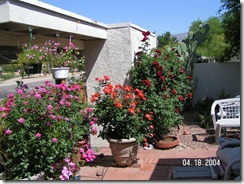
I sat in the back yard every afternoon for one to two hours with binoculars and bird books. I sat in my office, gazing out at the astonishing birds when I wasn’t busy typing, and sometimes even when I was.

Gila and White winged dove 5-7-2010 8-17-55 AM 855x908White-winged dove and gila woodpecker

The first unknown bird I remember seeing was a large black-and-white striped bird pecking on the trunk of my tangelo tree. I quickly learned that this was a Gila woodpecker, the owner of the loud, raucous voice that sometimes startled me when the window was open. I also learned that we had two types of doves: white-winged and mourning.
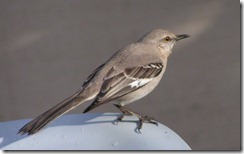
 Mockers new backyard 007
My first familiar bird was one I had gotten to know when visiting my parents in the Washingon, DC, area: the mockingbird. Now I could see these amazing, intelligent, and beautiful creatures close-up.

 
The next desert bird I learned to identify was the curve-billed thrasher, a close relative of the mockingbird. Hours of observation showed me that these gorgeous birds had yellow eyes, except when young (juveniles’ eyes are gray). They also invariably have a grumpy, peeved expression on their faces.

Curve-billed ThrasherCurve-billed thrasher; not my photo

I got to know these and many, many other birds over the first few years I was here. Most wonderful of all were the hummingbirds, and I will write about them in a future post.

Monday, July 16, 2012

MONSOON!

The monsoon arrived three weeks ago, with humidity but no rain for us. The pincushion (Mammalaria) cactus bloomed a couple of days after the first rains,

Pincushion (Mammalaria) 7-11-2012 5-15-33 PM 899x728

and it rained a lot, all around us, but the central part of Tucson was all but dry. Till yesterday, when a pair of storms, about fifteen minutes apart, brought us buckets of rain and impressive lightning and thunder.

Rain gauge 7-15-2012 7-00-16 PM 1837x2258

The rain gauge read 2.75 inches by the time it was over—the most we’ve ever had at this house.


Backyard lake 7-15-2012 7-01-29 PM 3616x2712


The back yard turned into a lake.


After the rain a beautiful rainbow formed over the houses across the street to the south:

Post-monsoon rainbow 7-15-2012 7-32-29 PM 3572x1980

With a saguaro at the end of the rainbow:Saguaro rainbow 1 7-15-2012 7-35-04 PM 1502x3063

Wednesday, July 11, 2012

A fallen giant: Saguaro tragedy

On my regular Monday morning rove at Tohono Chul Park, I was shocked to see the huge top half of a mighty saguaro lying on the Desert View Trail. The saguaro itself still stood, its remaining arms pointing skyward, but its main trunk was now a relative stub. This was the saguaro I posted about only a month ago, the large sentinel saguaro with a “window” in its side.

Damaged Saguaro 7-9-2012 8-28-05 AM 1352x2306                Saguaro top 7-9-2012 8-28-45 AM 2000x2681

I talked with one of the groundskeepers later. He said it might have been a result of too many woodpecker holes in one part of the saguaro. It’s also obvious looking at the photo in the previous post that the top of the saguaro was leaning rather precariously. My groundskeeper buddy joked that they could put out police tape and draw a chalk line around the fallen limb. We could call it CSI-TCP.

Technorati Tags: ,

Tuesday, July 10, 2012

Quail and Mockingbird Notes

Long-time readers of these posts—and anyone who knows me personally—knows that I’m fascinated by bird behavior. I’ve been closely watching backyard birds for more than twenty years, and every day I see something new.

Just now I’ve been watching quail at the quail block in my bird garden. We are at the height of baby-quail season, and there are several families, with chicks of all different ages. Some of the families are quite large: there’s a group with eight or nine kindergarteners (I’m thinking these might be the same guys I videotaped in my previous post). There are several families with high-school age and even older chicks—not much smaller than the parents. The largest such group that I’ve been able to count had seven adolescents, though most older groups have two to five surviving offspring..

I should really install one of those “take-a-number” machines; the families take turns, waiting for the previous family to finish before coming to the quail block. They are sometimes lined up just outside the fence. Whenever a solitary quail or an overeager youngster tries to join the party before the previous group has left, there is a lot of squawking and running at the intruder. It is very fun to watch.

                                   mocker head-on

For another view of bird pecking order and sharing (or not) of resources, check out this discussion of a possessive mockingbird at my previous home.

Saturday, June 30, 2012

Quail Update

I haven’t posted a quail update in quite some time, though I am as obsessed with these beautiful birds as ever. A few weeks ago someone at the Park commented that it was a poor quail year, with very few babies. This person does not spend the summer in Tucson. While some broods appear as early as late April, the majority of chicks are hatched once the weather gets really hot (see my comment on quail babies in an earlier post).

This year is a banner year for quail. Families of all sizes, with babies of all ages, are everywhere—in my yard, in my neighborhood, at Tohono Chul Park. Several broods of chicks are already mature looking, though not as large as their parents. Others are recently out of the egg. One interesting group of six are what I think of as teenagers—and they are on their own with no adults. They always hang together, and I haven’t seen them enough to tell if one of them acts as the leader.

This family group with ten very young chicks (I’m guessing no more than a couple of days old) showed up in my back yard bird garden yesterday afternoon. It was VERY hot, so they tried the shade of the porch.


Ten Gambel’s quail chicks and their parents.

Thursday, June 28, 2012

Kingsnake heaven

Look who I found on my back porch when I was watering this morning!

Juvenile kingsnake June 2012 6-28-2012 6-09-11 AM 2286x763

                                                        Juvenile Common Kingsnake

This little beauty is about eighteen inches long and has strikingly beautiful markings. He does not, however, like to be watered.

I feel so fortunate—I have Leo, the big kingsnake, in my guest room, and now this little guy hanging out in the backyard, at least for a while. Here’s a video of him trying to escape the photographer. He also sidewinded a little, but I didn’t get it on pixels.

           
Juvenile kingsnake on back porch, June 28, 2012
Technorati Tags:

Tuesday, June 26, 2012

The Snake in my Guest Room

On Fridays at Tohono Chul Park, we offer a reptile show, Reptile Ramble, in which two herpetologists talk about and demonstrate a number of local reptiles, assisted by docents. I always feel incredibly fortunate when I get to be one of those docents, because I consider that show one of the most important things we do at the Park. It educates visitors about how to tell one snake from another, and why they shouldn’t fear or harm any snakes, even rattlesnakes.

I also love the show because I have fallen in love with the snake I demonstrate most often, the beautiful, beautiful Common Kingsnake. The snake’s owner is going away for July and August, and this year he asked me if I’d take care of “Leo” (the king) for him while he’s gone. I jumped at the chance, and yesterday Leo moved into our guest room. Here are a couple of pictures of Leo from Reptile Ramble, showing his incredible beauty:

How many fingers  6-24-2011 10-47-26 AM 1480x1777Common Kingsnake and fingers

snakehands 10-15-2010 10-17-17 AM 328x344Leo, performing in the Ramble

And here is Leo’s cage, with just a glimpse of Leo hiding in his little rock cave. I’ve been in to say hello a few times today, and he is no longer retreating the second I show up. Perhaps soon I can get a picture of him more relaxed and stretched out. In a future post I’ll tell you more about this remarkable species.

Aquarium side 6-25-2012 2-14-22 PM 3523x2055

                                                                     Leo’s glass-sided cage

Sunday, June 24, 2012

Bloom Night 2012

Last night was our famous “Bloom Night,” the one night in the year when the Night-blooming cereus (Peniocereus greggii)  performs her magic and hundreds of flowers open all at once. It doesn’t start till after sunset, and the flowers blossom all night, to be pollinated by hawkmoths. They open at the same time because they cannot self-pollinate. Apparently they communicate with each other across the desert through some sort of chemical signaling.

At Tohono Chul Park, we have a big “block party” for the whole city on Bloom Night, and hundreds of visitors roam our luminaria-lit trails admiring and photographing the beautiful blossoms.

Last night I was stationed at the back end of our longest desert trail.

Pink sunset at Bloom Night 6-23-2012 7-56-46 PM 3616x2712

                                                           Sunset on the Desert View Trail

When I first got there, Emerald, one of the most spectacular and prolific plants, was just barely beginning to open its tight greenish buds:

Emerald buds 6-23-2012 7-10-18 PM 1902x2276Emerald, with ten green buds

Its companion plant, “Little Sister,” was already about halfway open, showing its lovely pink petals.

Little Sister 6-23-2012 7-09-59 PM 1484x1116

                                         Little Sister, about halfway open

As it got darker, night hawks and bats emerged, chasing insects. By the time it was fully dark, Emerald was more than half open. Emerald 6-23-2012 7-52-05 PM 2286x2465People lined up twenty and thirty deep for a chance to take its picture.

Saturday, June 23, 2012

Baby Cooper’s Hawk

Yesterday morning I had a bird tour at the Park. Despite the extreme heat (by tour time in the low nineties, with a high dewpoint), four people showed up and we had a wonderful time, sticking to the shade and checking out the local birds that choose to spend their summer with us.

We were on our way to look at the hawk nest in the riparian area

          Cooper’s hawk nest    Hawk nest 2-29-2012 8-56-25 AM 1927x2690

when a fellow docent, along on the tour for the fun of it, silently pointed to a bird sitting on a branch above the stream. It was one of the baby hawks!

 Baby cooper's hawk 6-22-2012 9-48-28 AM 1810x1698

                                   Baby Cooper’s Hawk at Tohono Chul Park

The picture doesn’t really show how relatively small this little guy is. The photo does show the baby fluffy feathers that haven’t finished molting. To me, it looked a little uncertain as it moved about on the branch, possibly trying to get up the nerve to jump—or fly!—to another one. A little searching revealed a parent hawk nearby, watching over the little one.