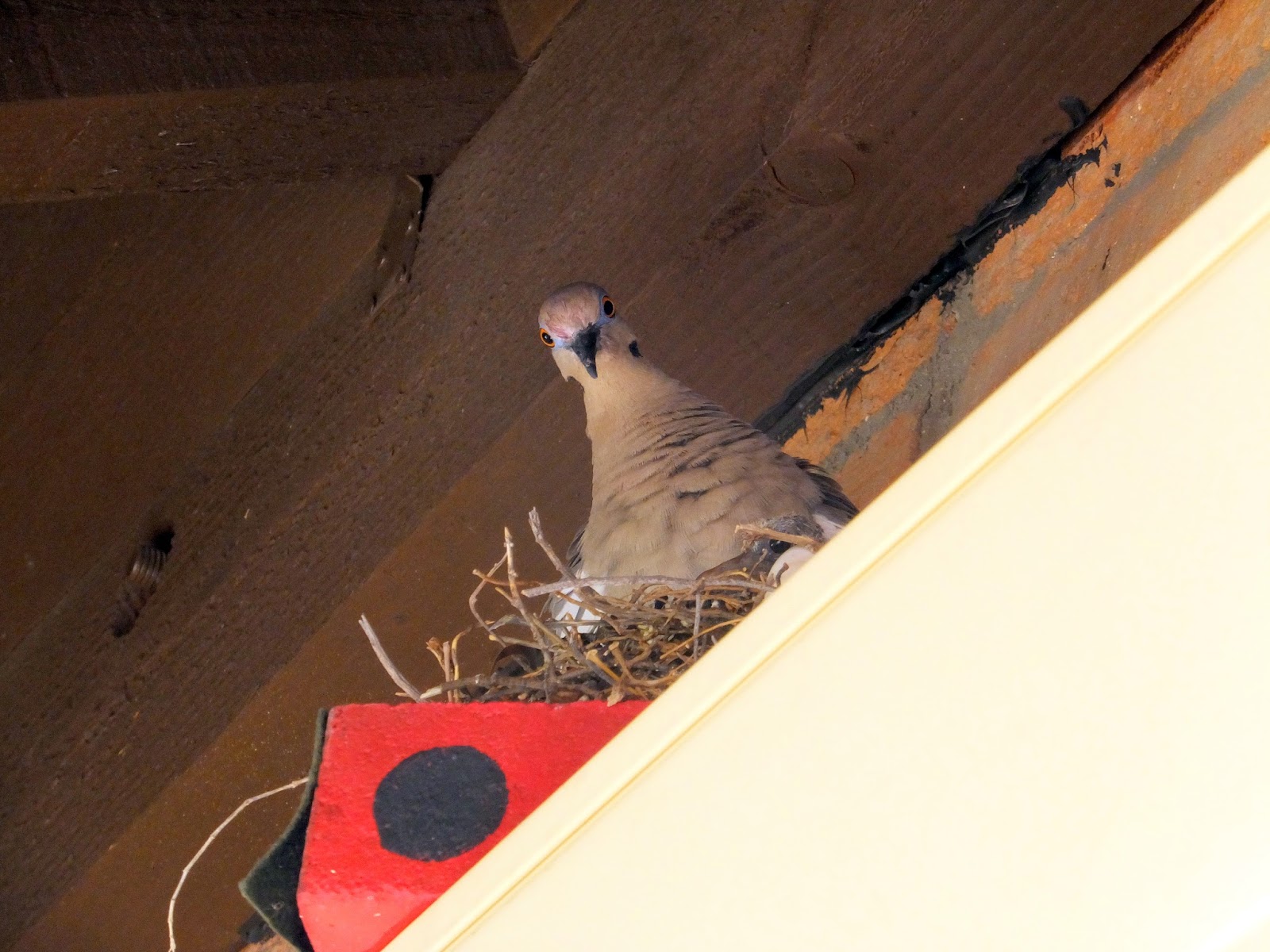
White-winged dove season is finally over. There are only a handful of these beautiful birds remaining, and soon they will be gone too, back to Mexico, where they spend the winter. It is always a sad time for me, because I can't know for certain that I will be here to greet them when they return next spring.
Below is a collage I made to celebrate my love affair with doves over the last few years. Most of the photos are of white-wingeds, but there are some mourning doves here too. Some notes on the collage follow.
Upper row shows doves being doves, doing dove things. The fourth photo over, of the long-beaked juvenile white-winged, was an exceptionally clueless dovelet who repeatedly flew into a brick wall in the carport of our previous home. He always seemed okay afterward, and I'm hoping he survived.
The central large photo is a nearly grown mourning dove fledgling who hung out in my private patio for a couple of weeks. I took the photo because I thought he was beautiful. The upper photo to the left of the mourning dove was one of my most-recent white-winged fledglings being fed in the patio by its mother. Adult doves produce a nutritious liquid in their crop (called "pigeon milk"), which they pump into the babies in a procedure that looks like a vicious mugging.
Immediately to the right of the central dove is a male white-winged holding a curved stick in his beak. I spent around an hour one morning watching him and his mate building a nest on the precarious top of a pole. The process was fascinating.
Just to the right of the nest-builder is a very, very special mourning dove who nested in a particular yucca at Tohono Chul for three years. She had the best-made, safest nest I ever saw for a dove. I thought she was a genius. I used to imagine that some day her offspring would take over the Park, producing a race of super-smart doves. But after three years the yucca grew in such a way that it no longer had a perfect nesting spot, and I never knowingly saw her again.

Finally, the small dove in the lower right-hand corner is an Inca dove I photographed in the Walk-in Aviary at the Arizona-Sonora Desert Museum. Inca doves were very common when I first moved back to Tucson in the late 1980's, but gradually disappeared from the central part of town and are now seldom seen. They are beautiful, sweet, very small doves with cinnamon-colored underwings and feathers that appear from a distance to be scaled. Nobody knows for sure why they have disappeared, but a common theory is that the very large Cooper's hawk population here has done them in.
If you have questions about any of the other doves in the collage, feel free to ask them in the "comments" below. Every dove has a story.
Friends on social media know that for the last several weeks I've been obsessed with a particular white-winged dove that nests on my private patio above my sliding door. White-winged doves are among my favorite birds for many reasons I have detailed in an earlier post. This particular bird drew my interest more than three weeks ago when nearly all the other neighborhood white-wings returned to Mexico before a storm arrived. I have been thinking of her as Paloma, Spanish for Dove (and for the Holy Spirit).
I assumed Paloma was waiting for her babies to fledge, but it soon became clear there were no dovelets in the nest, at least none that I could see. Worse, an egg fell to the ground one day and two days later another egg appeared on the edge of the nest, balanced but not being brooded. Doves usually lay two eggs per clutch, and obviously neither of these would hatch. So why was she still up on the ledge?
I speculated that maybe Paloma was too young to realize she was supposed to join her friends in flying to Mexico. Or that she had been abandoned by her mate. Or... Or... really, why was she still sitting on that nest?
Yesterday, I found out why, when Palomita, Paloma's adorable baby, appeared on the ledge, next to the balanced egg. But this produced a new obsession. Where was Paloma herself?
I did not see her for the rest of yesterday afternoon, even late in the day, and she was not on the nest this morning.
Had something happened to her, after all the hard work of brooding this sweet baby dovelet? Would I have to find some way to remove the fledgling from the ledge and learn how to feed it?
By late this morning, still no sign of Paloma. And then I happened to walk by one of the glass sliders to the back yard, and there she was on top of the fountain.
I looked through my binoculars to make sure it was the same dove (she has a healing injury next to her right eye). It was almost as if she had landed there, and stayed there, to make sure I would see her and know that she and her baby are safe. Please join me in wishing them well when they begin their perilous journey back to Mexico.