Monday, March 18, 2013

My first day of Spring

I have had to be away from Tohono Chul Park for nine days. In my absence, spring arrived. The flowers are flowering, and the birds are nesting. The desert tortoises have emerged from their dens.  It is beautiful and thrilling. Best of all, the first white-winged dove of the year  arrived today, though I did not get a photo.

PenstemonMystery penstemon 3-18-2013 8-44-53 AM 1789x847

Mexican honeysuckle                                   Texas Mountain Laurel

Mexican honeysuckle 3-18-2013 8-31-50 AM 1660x1338             TX Mountain Laurel 3-18-2013 8-50-28 AM 2437x1652

Bluebells and gold poppies in the Cactus CircleBluebells and Gold poppies in the cactus circle 3-18-2013 8-34-10 AM 3616x2212

Desert Tortoise                                            Cooper’s Hawk Nest

Desert Tortoise 3-18-2013 8-39-40 AM 2580x2148             2013 hawk nest 3-18-2013 8-54-59 AM 3375x2666Genius MODO 2013 3-18-2013 8-51-28 AM 2057x2693

Mourning dove nest in a yucca, and, below, a verdin building a nest

Verdin working on a nest


Friday, March 01, 2013

A thrilling bird concert

Curve-billed Thrashers and Northern Mockingbirds are two of my favorite birds. They are actually closely related—both members of the bird family Mimidae. Their bodies are nearly identical, but the slightly-smaller mockingbird is grey, white, and black, while the thrasher is mostly grayish brown. Mockingbirds have yellow eyes and a short straight beak, while the thrasher’s eyes are orange and its bill  long and distinctly curved. Both birds eat insects, seeds, and berries, though the thrasher is more of a desert dweller than the mockingbird, which is often found in urban environments.

Mockers new backyard 007          CU curve-billed thrasher 11-12-2012 12-22-40 PM 497x855

Mockingbird                                    Curve-billed thrasher (Sue Feyrer)

Both birds excel at singing. Nearly everyone has heard the beautiful, ever-changing trills of a mockingbird in the spring, but not everyone knows that thrashers can sing nearly as well. The thrasher’s ordinary call is a piercing upside-down wolf whistle (whit-WHEET!), but their song is beautiful and very melodious.

This morning at Tohono Chul Park I heard beautiful birdsong on one of the desert trails. As I approached, a mockingbird flew into a tree above me, but it was not singing. I followed its gaze to see this beautiful thrasher singing its heart out.

Curve-billed thrasher singing on a saguaro

Monday, February 25, 2013

Cactus Wrens Courting on a Crested Saguaro

After snow, ice, severe winds, and very cold temperatures, spring started to reassert itself today in the Sonoran desert. On my rove at Tohono Chul Park this morning, I saw these beautiful early wildflowers: Arizona blue bells with a few Gooding’s verbena mixed in.

Bluebells and verbena 2-25-2013 9-04-26 AM 3556x2473It was gloriously beautiful out on the desert trails. The saguaros on this hill seemed to glow in the beautiful warm sunshine. The saguaro on the extreme right is a rare cristate saguaro. These saguaros (and some other cacti, such as barrels) have suffered a change or injury to the growing tip and no longer grow from a point. See this link for a fuller explanation, and look at the video below for a closeup of the crest.

Saguaro hill 2-25-2013 9-32-05 AM 3216x1664

I climbed the hill to take a closer look at a very vocal cactus wren that was perched on the saguaro’s crest. While I watched, another cactus wren landed next to the vocalizing bird, and both fanned their tails in what I took to be a very provocative display. I believe they were courting. Here is a brief video of their behavior, up to the point where the second wren flew off.

Cactus wrens courting atop a crested saguaro

Thursday, February 21, 2013

The Great Tucson Blizzard of 2013

It snowed here yesterday. I mean major snow, not like that I chronicled in  a recent post. Big, soft, wet flakes fell thickly through the air, starting around noon and not ending till sometime in the evening. In parts of the city, including mine, the snow accumulated, creating phantasmagorical shapes and patterns on the desert plants. Here are a few of the photos I took around my house and my neighborhood.

Snowy Saguaro2 2-20-2013 1-04-14 PM 3272x2689

2

Palo verdes in snow 2-20-2013 6-05-05 PM 3616x2073 - Copy   Palo verde trees weighted by snow

Study in snow with grapefruit 2-20-2013 6-06-36 PM 3616x2712 My bird garden covered in snow—see the grapefruit?

Saguaro snow glow 2-21-2013 7-31-40 AM 372x823 A snow-frosted saguaro arm glows at sunrise

Dawn Snow2 2-21-2013 7-22-47 AM 3616x2712

The rising sun illuminates snow-covered peaks and clouds

Wednesday, February 13, 2013

Desert Snow

We’ve had two wet cold fronts pass through lately, leaving rain in the valley, snow on the mountains, and misty fog everywhere. As a companion piece to my posts about blue skies and clouds, here is what it looked like at Tohono Chul Park.

Bestest snow Park 2-9-2013 8-44-20 AM 2048x1536

And on a wetter day, this was the view from our house:

Snow Jan 13 2-12-2013 7-28-08 AM 3607x2261

snow and fog 2013 2-12-2013 7-28-13 AM 3253x1641

Friday, February 01, 2013

Desert Clouds

Although our skies are often dramatic, it is unusual for a Tucson day to actually be cloudy, especially in the morning. Such a day occurred on my last rove. When I arrived at Tohono Chul Park at 8 AM, the sky was churning with clouds. It had rained over the weekend, and everything smelled damp and delicious. The cold, moist air seemed literally to caress my skin as I walked along the Desert View Trail, watching and listening to birds and looking for jackrabbits.

morning clouds 1-28-2013 8-06-56 AM 3264x2448

Evidence of the weekend’s rain could be seen all along the trail.

Damp trail 1-28-2013 8-08-23 AM 2590x1088

desert trail panorama 1-28-2013 8-09-17 AM 7616x2332

As I neared the end of the trail the clouds closed in and I could see only a tiny dot of blue sky.

A dot of blue 1-28-2013 8-17-25 AM 2448x3264

Just after I left the Park, the clouds opened up and it began to pour, a surprise for mid-January.

Thursday, January 24, 2013

Desert Skies

After record-breaking low temperatures last week (in the high teens), yesterday we broke the record high (low eighties). And today it’s cloudy and mild. The sky has been spectacular. Here are a few sky shots, including one from Sabino Canyon last Sunday:

Sabino Blue Sky 1-20-2013 1-00-32 PM 2048x1235

And from various locations in my yard:

backyard sunset 1-20-2013 5-44-33 PM 3236x1536

Saguaro sunset 1-20-2013 5-54-52 PM 2048x1536

pink mountains 1-20-2013 5-47-15 PM 2033x784

front yard sunset 1-20-2013 5-58-56 PM 1939x1144

Saturday, January 12, 2013

A Blast of Winter

The cacti are still wearing their styrofoam “hats,” and will continue to do so for several days, as winter has made a big comeback. We’re at the beginning of a five-day hard freeze, nearly unprecedented in this area. The last such, though it didn’t last as long, was two years ago. This is possibly the result of global warming.

Tohono Chul Park was very cold but beautiful today. There were plenty of birds, among them: phainopeplas, white-crowned sparrows, mourning doves, goldfinches, Abert’s towhees, Gila woodpeckers, curve-billed thrasher, pyrrhuloxia, house finch, house wren, cardinal and Gambel’s quails. But we saw no hummingbirds; this weather is hard on them. It kills the nectar flowers and small insects they subsist on. I hope that this year at least a few survive, because two years ago very few did. The biggest surprise today was this ice sculpture in the riparian area:

Icicles 1-12-2013 9-00-25 AM 2372x2232

Friday, January 04, 2013

Cactus Hats and Hints of Spring

The New Year has brought cold weather to the Sonoran Desert. But because we’ve had some rain and because it was so warm through most of December there are pockets of wildflowers coming up here and there, as well as blooms by some flowers that won’t be stopped by anything but a hard freeze.

Marigolds-chiltepins better 1-2-2013 9-14-24 AM 1688x2058                                Bluebells 1-2-2013 9-14-02 AM 967x1971

Desert Marigolds and Chiltepin fruits                           Arizona Bluebells

In most of Tohono Chul Park, our plants meet more hospitable conditions than those out in the desert. We irrigate many flower beds, and surround them with wire to keep out rabbits and javelinas. And we cover many non-native plants on nights when freezing conditions are expected.

Horse and cactus with hats 1-2-2013 8-59-31 AM 3264x2448

These Mexican Fence Posts and other columnar cacti grow from the top of the stem, so it’s necessary to protect the delicate growing tip from freezing. We do this with styrofoam drinking cups. The next morning it is always a cheery sight, with the covered cacti looking something like a Shriner’s convention. (I personally think we should put tassels on the cups, but so far nobody has taken my suggestion.)

Fencepost cactus and cups 1-2-2013 8-59-03 AM 3264x2448

Tuesday, December 25, 2012

Christmas in the Sonoran Desert

It’s chilly here in the early morning—in the forties—so I have to bundle up for my rove at Tohono Chul Park. Below two cold, Christmasy sights:

6 Doves in an Agave 12-3-2012 8-59-23 AM 2904x2202

We have neither partridges nor pear trees at the Park, so how about six mourning doves in an agave?

As for snow on the ground, we don’t have that either, but on very cold days frost forms along the trails. Here’s a video of frost on a prickly pear skeleton, sublimating into the air as the sun begins to warm the desert floor.

Steaming cactus skeleton

Happy holidays to all my readers!

Saturday, October 27, 2012

Ducks!

Yes, I live in a desert, and no, we don’t have a coastline here in southern AZ. But we are fairly close to the Gulf of California, and we get a lot of shore birds passing through and/or spending the winter right here in Tucson and in other parts of southern Arizona.

If you like ducks (and who doesn’t?) there are a number of places in the Tucson area where you can see them.        

Ducks in Reid Park, Tucson, Arizona

Sweetwater Wetlands, a sewage treatment plant fairly near my home,  does not smell sweet but harbors water birds all year round, and particularly in the cool/cold months. Water birds also frequent Aqua Caliente Park, a beautiful nature preserve in the far eastern part of Tucson, that is fed by natural warm springs. The city of Tucson itself is graced with a number of large city parks with ponds and artificial waterfalls and fountains.

I visited one of these parks, Reid Park, twice in the last ten days. Reid Park, which also has a zoo and a golf course, is in the center of town. Its two large ponds not only attract ducks, they also draw migrating and overwintering waterfowl of many different sorts. Last week, for example, I saw a cormorant, a great blue heron, and a seagull! The park itself is grassy and dominated by large evergreen, palm, and eucalyptus trees, which many of the waterfowl seem happy to perch in.

Here are some of the beautiful birds I saw on my recent visits:

Great Egret neck 10-16-2012 9-26-32 AM 1021x2681                 Great Egret best 10-16-2012 9-26-43 AM 2821x2588

These photos are of a Great Egret that was visiting the pond. I watched it swallow a fairly large fish, which you could follow down that long, slender neck. It’s a gorgeous bird that seems to like to roost in a eucalyptus tree.

Ring-necked duck best 10-25-2012 9-13-58 AM 1608x1158                 Coot 10-25-2012 9-04-23 AM 928x1384

These are two of my favorite ducks, the ring-necked duck on the left, which I like because it is beautiful and because it has a prominent ring on its bill (a much fainter one on its neck); and the coot, which is beautiful shiny black and has blue feet with weird-looking toes, padded for walking on marshy ground. The first time I saw a coot’s feet, I thought they looked like blue crayfish.

Finally, I saw a large, gorgeous bird I had never seen before, a black-crowned night heron, which posed both in a tree and beside the pond:

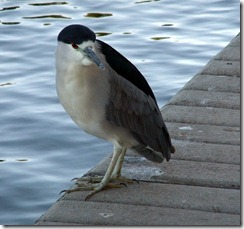
Black-crowned night heron in tree 10-25-2012 9-10-43 AM 1939x2487             black-crowned night heron on ground 10-25-2012 9-14-57 AM 2403x2257

Friday, October 19, 2012

Mid-October Birding at Tohono Chul Park

Today was a terrific day for a bird walk in the Park: clear blue skies and temps in the low seventies. I was greeted almost as soon as I arrived by white-crowned sparrows, which I had not seen since early spring.

white-crowned's crown 12-20-2010 9-41-10 AM 732x591

In the front of the Park, a rare treat: a cactus wren building a nest in the saguaro at the top of the trail that enters the Park!

                      Saguaro with nest at TCP 10-19-2012 8-49-26 AM 2299x2421

Cactus wrens build messy, football-shaped enclosed nests throughout the year. Nobody knows why they build multiple nests—possibly some of them are decoys. It’s not unusual in any given month to see a cactus wren with nesting material in its beak.

Cactus Wren Building Nest in Saguaro

  This wren repeatedly selected material from either side of the path, flew up into the cactus, added the new nesting materials, arranged them carefully, then flew back to the ground to repeat the process. Here is a brief video showing the bird’s efforts.

Cactus wren building nest in saguaro at Tohono Chul Park, Tucson AZ

Sunday, October 14, 2012

Why do hummingbirds fight?

“Cool it, guys! There’s plenty for everybody!”

Yes, I do talk to my birds, and often exhort the hummers to play nice with one another and stop fighting over the feeders. These fierce little jewels always ignore my advice. I recently read a discussion on a hummingbird mailing list that goes a long way toward explaining this aspect of hum-behavior.

According to Lanny Chambers, a hummingbird expert whose excellent website, Hummingbirds.net, is packed with photos and information on hummingbirds, hummers fight because:

 Anna flying

…they treat feeders essentially the same as flowers. A good patch of wildflowers in the middle of nowhere will provoke chases and battles, as one bird tries to defend the territory against all intruders. So, the real question is, "why are hummingbirds so territorial?"

The answer for adult males in spring is easy: the birds with the best territories attract the most females, and get the most sex. Hens want strong genes for their chicks, and they know where to find them: the nastiest, meanest, most evil-tempered studs will be successfully holding down the most desirable food resources.

Outside of that scenario, each flower contains a tiny amount of nectar, replenished slowly over time. A hummer doesn't want another bird to get the nectar first, since it will have to wait until the flower produces more, so the resource is jealously guarded. I don't think a hummingbird has any concept of unlimited supply, so they defend feeders for the same reason.

There are some occasions on which hummingbirds will share food. I myself have observed this, most often at the end of the day or during a cold snap. A couple of years ago two young male Costa’s hummingbirds uneasily co-guarded my patio feeder, as I described here. But this behavior is very rare.

Costas2 5-25-2011 5-01-54 PM 2447x1044

Nancy L. Newfield of Louisiana, author and hummingbird expert, believes the hummingbirds’ perception of the rarity of nectar is “the crux of the whole matter.Every drop of nectar is regarded as the last drop of food on Earth.  They defend their food source because their very life depends on food.” 

Adds Sheri L. Williamson, another expert, who is author of the indispensable Peterson’s Field Guide to Hummingbirds of North America, “It’s all about that limited resource and walking (well, hovering) a very fine line between survival and starvation.”

Sunday, October 07, 2012

Butterfly Sex Notes

Birds do it, bees do it, and butterflies do too. Early fall is butterfly heaven in Tucson, and Tohono Chul Park is jam-packed with many beautiful species of butterflies. 

Here are some beautiful queen butterflies, sampling the delights of ageratum:

             butterflies and ageratum2 great 9-7-2010 8-53-49 AM 3616x2712

The butterflies are males (as evidenced by the black-enclosed white dot on their hindwings), and they are imbibing an alkaloid that will help them produce a pheromone that some references say “aids in mating.” My butterfly app says that the pheromone enables them to “subdue the female,” so you might think of it as a butterfly date drug.

These pipevine swallowtails were caught mating in the top of a palo verde tree:

Pipevine Sex best 9-24-2010 8-40-29 AM 442x339

Two days ago, while on a bird walk, my buddy Sue and I saw a young butterfly emerge from its chrysalis. In this brief video you can see the flashes of color appear:

It was a beautiful Gulf Fritillary,

Gulf fritillary 1 9-10-2010 9-07-02 AM 3616x2712

but we had to move on before it had dried out and pumped up its wings.

The very early life of a butterfly is fraught with peril. See how I rescued one in my earlier post on Butterfly First Aid.